Thursday, 19 November 2015
Clean 60T Bogie Bolster D
After a number of blog posts featuring various incarnations of the 21t coal hopper it's nice to be able to share something a little bit different - The unfitted 60T Bogie Bolster D.
British Railways decided that changes in the steel industry would require the use of more bogie vehicles. The wagons fitted with bolsters to support the load were mainly grouped according to length (and hence the nominal capacity).
The largest wagons were classed as Bogie Bolster D, being 52ft in length with a load capacity of 42tons. The first wagons built for BR were 150 vehicles built at Derby in 1949 to an LMS design, which BR described as Diagram 1/470. This featured five fixed bolsters and lashing down rings on the solebar. LMS diamond frame bogies were fitted.
The next 200 vehicles were to an LNER design, appearing in 1950, as Lot 2211 to Diagram 1/472 with the outer 2 bolsters moveable between 2 locations and lashing rings set into the floor of the wagon. They were fitted with LNER diamond frame bogies.
1951 saw the appearance of Lot 2237 and with it, the change to GWR style plate bogies set the appearance of the vast majority of Bolster D, with over another 1600 unfitted Dia. 472 vehicles constructed in 14 lots until 1958. It is these wagons which feature in our 60T Bogie Bolster pack for Train Simulator.
Saturday, 14 November 2015
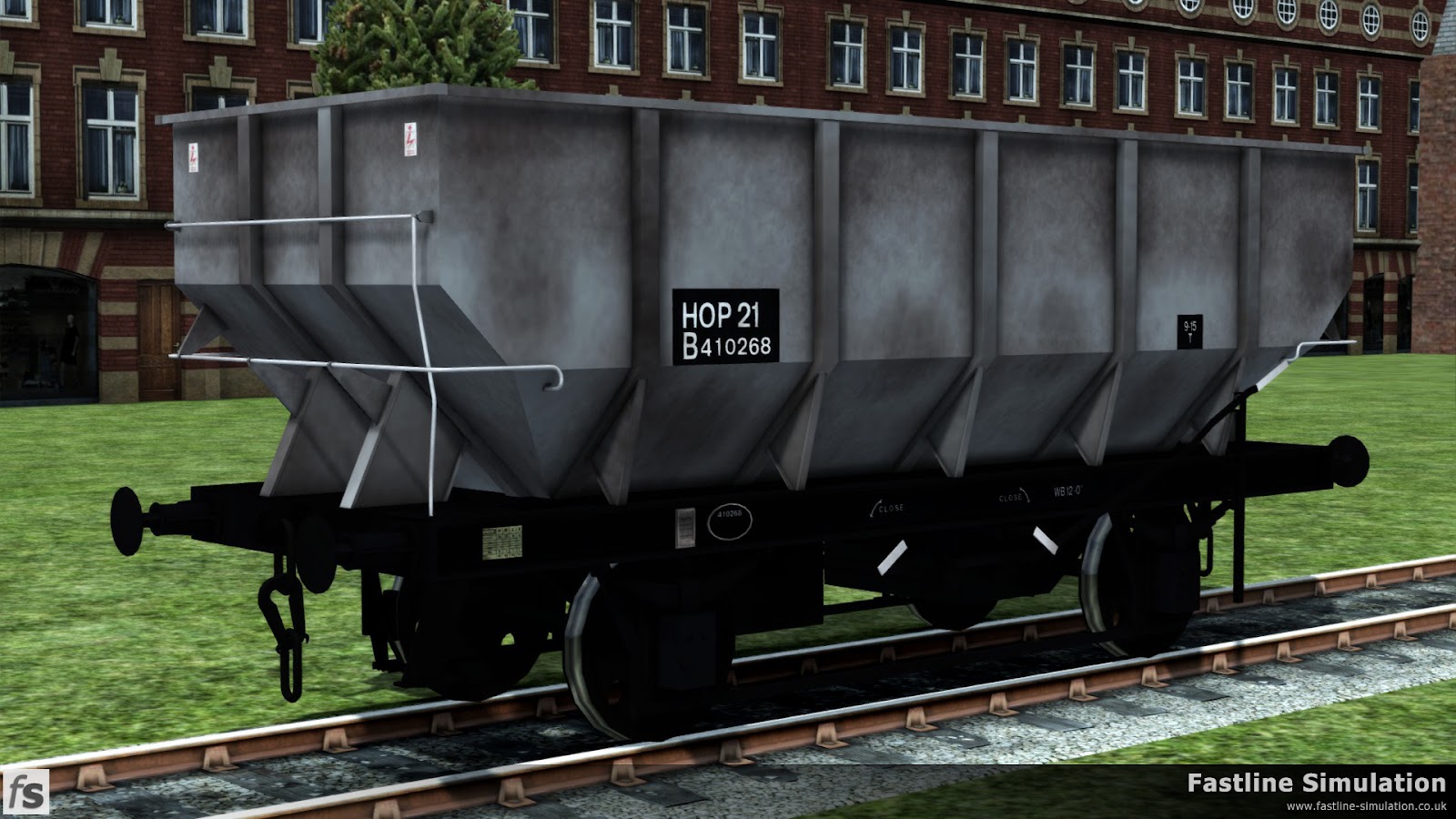
Unfitted dia 1/141 21t HTO Coal Hoppers
Continuing our exploration of the complex history of 21T coal hoppers built by British Railways we're bouncing back to one of the earliest parts of the story with the diagram 1/141 hoppers. These were a direct descendent of the diagram built by the LNER and retained the LNER brake rigging and most noticeably the long LNER handbrake lever. Surprisingly the hoppers could still be found in use during the early 1980s and some were included in the various rebodying schemes - not something covered in this pack!
In keeping with the dia. 1/146 unfitted hoppers we previewed earlier in the week these hoppers worked hard and were subject to corrosion from the acidic nature of the coal that they carried. As a consequence we have prepared various levels of distress to allow the hoppers to created a varied rake of wagons. The hoppers also feature a number of different lettering styles which are applied at random but can be overriden to one of your choice should you desire.
Also in common with the dia. 1/141 hoppers these were unbraked and were not fitted with lamp brackets to carry a tail lamp as they were never envisaged to be at the rear of the train. Therefore, to allow users to be able to form correctly marshalled trains we will be bundling a dia. 1/506 unfitted brake van that we previewed in our 'Bonus Brake Vans - Part 1'.
Monday, 9 November 2015
Unfitted dia 1/146 21t HTO Coal Hoppers
Today we're looking back to a much earlier part of the story with the unfitted version of the dia. 1/146 hoppers which made up the majority of the wagons built to this diagram complete with the original style of body with five strengthening ribs and plain axleboxes.
Like most coal wagons these hoppers worked hard and were subject to corrosion from the acidic nature of the coal that they carried. As a consequence we have prepared various levels of distress to allow the hoppers to created a varied rake of wagons. The hoppers also feature a number of different lettering styles which are applied at random but can be overriden to one of your choice should you desire.
Given that the wagons were unbraked they were not fitted with lamp brackets to carry a tail lamp as they were never envisaged to be at the rear of the train. Therefore, to allow users to be able to form correctly marshalled trains we will be bundling a dia. 1/506 unfitted brake van that we previewed in our 'Bonus Brake Vans - Part 1' blog post a while ago.
Wednesday, 28 October 2015
RNA Barrier Wagons
Until the mid 1990s railway operations required the use of barrier wagons when trains were carrying Dangerous Goods to give better protection to train crews and the goods themselves in the event of derailment or collision. Traditionally these barrier wagons would be drawn from whatever suitable wagons were available in the yard at the time that the train was assembled. However, with the sectorisation of British Rail in the run up to privatisation all assets and requirements had to be accounted for.
With this in mind, Railfreight Coal assembled a dedicated fleet of barrier wagons for use with nuclear flask traffic. It is likely that a number of the wagons that were involved had been in use for this very purpose for some time but were now formally assigned and converted for the role. A large number had their hopper bodies removed and a new floor added. Alongside this they gained a coat of the new Railfreight Sector livery complete with coal branding.
Other hoppers retained their bodywork but gained a repaint in the Sector livery while others were simply recoded as RNA while retaining their previous liveries.
Monday, 26 October 2015
Bonus Brake Vans - Part 1
Those of you who have been following us for a while know that we like to throw in the odd extra when it comes to our Train Simulator expansion packs to make them a little more realistic. Today we're showing off a couple of items we've been finishing off to bundle with a number of our forthcoming Marketplace releases.
With the Sectorisation of British Rail, image and accountability became a very important part of the business. Ironically, even in this modern business, there was still the need for traditional railway technology including the humble brake van.
Where the transportation of dangerous goods or particular operating arrangements were in place there was still a requirement for brake vans to be used for the use of the guard or other members of the train crew. As a consequence, a number of the later built dia. 1/507 20T brake vans with through air and vacuum pipes (TOPS code CAR) gained fresh coats of Railfreight sector livery complete with sector branding.
We have created this model for inclusion in our RNA barrier wagons pack that is due to be released on Steam Marketplace very soon. The model features coal sector decals by default but these can be changed through the use of number prefixes to any other decal if you so desire. Given the period of use this van is fitted with a single early design battery flashing tail lamp controlled via our intelligent tail lamp scripting.
Turning the clock right back we've also been working on a more original unfitted dia. 1/506 brake van with plain axle boxes. A considerable number of these vans were built in the early 1950s both in the form represented here but also with through vacuum pipes and in some cases, were fully fitted with vacuum brakes.
Given that unfitted wagons were not fitted with lamp irons and would not be expected to run in train without a brake van this model is currently scheduled to be bundled with a number of our forthcoming expansions including the unfitted 21t hopper packs and the BDO bogie bolsters.
The dia. 1/506 vans feature a selection of randomised or controllable lettering styles along with clean and weathered textures. By default the vans display three oil lamps (with the side lamps being randomly black or white) denoting a partially fitted or unfitted train but this can be overridden if desired to show a single lamp for a fitted train.
Both of the vans shown are supplied with smoking and non smoking stove pipes. The smoking variant has dynamic smoke that changes over time reflecting changes to the fire in the stove.
We do have plans to create further versions of both these vans which will be bundled with future expansions as appropriate.
Subscribe to:
Posts (Atom)